A Brief History of Hooked Rugs
By Jubilee P. Reid
Rug hooking is one of many textile arts which originated from a necessity but exists today solely as an art form. Hooked rugs are made by looping strands of fabric or yarn into a stiff base fabric such as burlap, using a tool similar to a crochet hook. There are three main techniques for making hooked rugs: traditional, punch, and latch hooking. The traditional and punch methods differ in tools and in direction the yarns are pushed to create the loop. Latch hooking evolved later and involves knotting the yarns in a different manner.
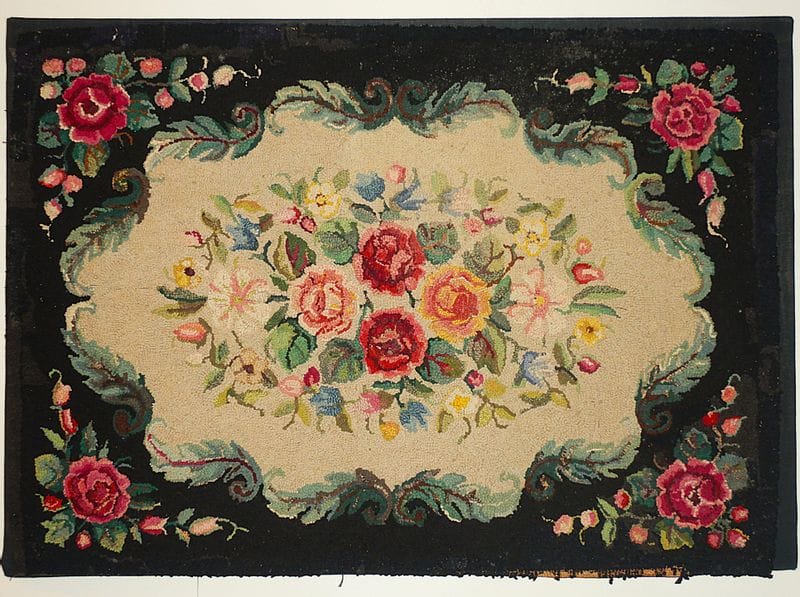
Among the McMinn County Living Heritage Museum’s extensive collection are multiple antique hooked rugs featuring a variety of designs. A few have been modified into other items such as decorative pillows, yet most remain in their original form as small floor coverings. One dramatically colored rug, displayed in the museum’s textile exhibit, features several types of multicolored flowers on an oval cream-colored background. Surrounding the cream is a wide black border with swirling leaves and roses in the corners. This rug is 42 by 30 inches and is believed to have been made in Apison, Tennessee in 1957 by a Mrs. A. C. Huber. She donated it to the museum in 1982. Although a mid-century example, the design of this rug is quite typical of a late 1800s hooked rug.
While the hooked rugs in the museum’s collection are mostly from the mid-20th century, the history of this textile art extends far prior to the 1950s. Some believe that rug making originated with the Vikings in Scandinavia and was passed from there to the British Isles. However, evidence indicates that this technique likely existed in many cultures predating the Vikings. Often, methods for textile creation are “invented” simultaneously in multiple places, and no one culture can claim original invention. Hooked rugs, created in a method similar to modern techniques, existed in 4th century Egypt.
Rug hooking, as it is known today, is believed to have originated in Yorkshire, England in the early 1800s. According to folklore, English millworkers were allowed to collect yarn scraps shorter than nine inches from the floors of textile mills. Called “thrums,” these scraps were too short to be used in the mills; therefore, millworkers were allowed to keep them. These short strands of yarn were looped through a backing fabric, generally burlap which was readily available, (later rug warp was used) to make small household rugs. These early hooked rugs did not feature the elaborate floral motifs common in later rugs; instead, they featured simple designs or no design at all.
Rug hooking soon traveled throughout Western Europe and to North America, becoming particularly popular in New England and Eastern Canada. At this time, the price of commercially produced rugs far outweighed the cost of handmaking one’s own. Handmade rugs were often considered a trademark of the working class as wealthier families could afford machine-made rugs. In North America, strips of scrap fabric (often wool) were used more commonly than yarn. The United States had fewer mills than England resulting in fewer scrap yarns available.
In the latter half of the 19th century, rug hooking patterns began to be produced, particularly in New England where Philena Moxley (1844 – 1937) was among the first to sell patterns. An enterprising woman, Moxley opened a store in 1865 in Lowell, Massachusetts, a town known for its textile mills. She created over 2,000 designs of stamping blocks for printing embroidery patterns along with larger patterns for rug hooking. These stamps were created using thin strips of metal embedded in wooden blocks. The stamps were then used to mass produce patterns. Floral motifs are among the most common but animals, landscape scenes, and geometric patterns were also produced. Other businesses soon sprang up to produce their own patterns for rug making kits.
By the early 1900s, rug hooking fell into decline in the United States as commercially produced rugs became more affordable for lower income families and the quaintness of these rugs was losing popularity. However, interest in this art form was revitalized in the 1950s when rug hooking associations began to be formed to study and promote this art. Today, many resources are available for those who are interested in learning this antique creative skill.
4th Annual Trade FairThe McMinn County Living Heritage Museum is preparing to host its 4th Annual Living Legacy Trade Fair. Sponsored by the Tennessee Arts C...
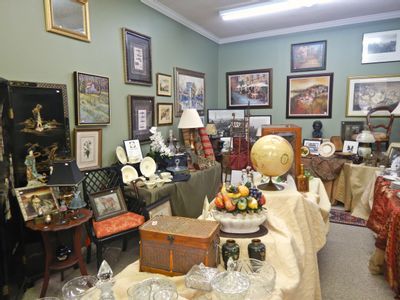
Trash & Treasure Sale 2025It is time once again for the McMinn County Living Heritage Museum’s Trash & Treasure Sale! Hosted by the Museum Guild, this annual spri...
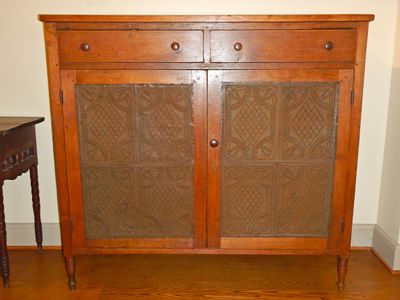
A Sample of Tennessee FurnitureCurrently on display in Gallery One of the McMinn County Living Heritage Museum is a 16-piece collection of antique furniture. Most of t...
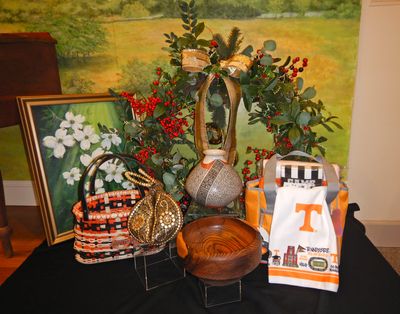
Holiday House 2024The holiday season is quickly approaching which means the McMinn County Living Heritage Museum is preparing to host its annual Holiday H...

History for Lunch: Forensic Anthropology: Where Science ... Read More
Oct 22, 2026
12:00 PM EDT
522 W Madison Ave
Athens, TN 37303